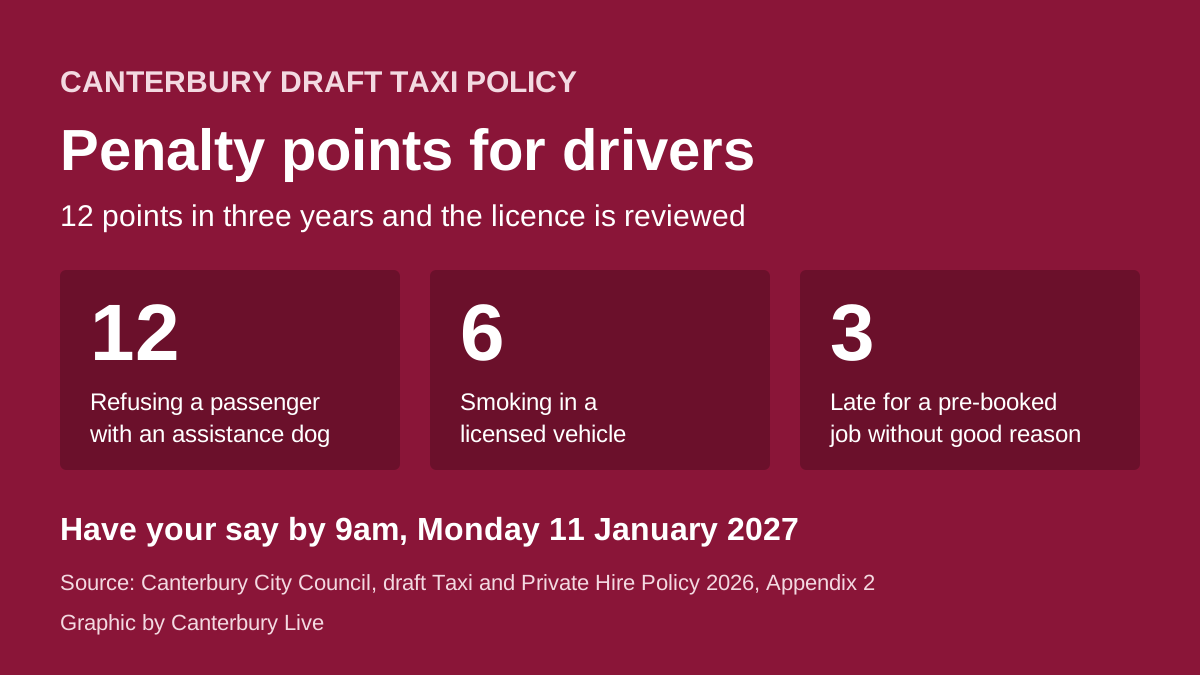

Canterbury taxi drivers would get penalty points for breaches, with 12 in three years triggering a licence review. The consultation closes 9am on 11 January.
Taxi and private hire drivers in the Canterbury district would be given penalty points when they break the rules, under a draft policy now out for consultation. A driver who builds up 12 points in three years could be called to a hearing and have their licence suspended or revoked.
Canterbury City Council published its draft Taxi and Private Hire Policy on 22 October. The consultation runs for 12 weeks and closes at 9am on Monday 11 January 2027. Drivers, operators, passengers, businesses and residents can all respond.
The council says the draft is “largely the same in format and content” as the current policy. These are the main changes it lists:
- a new penalty points scheme
- Disability Awareness Training for every new and existing licence holder
- automatic refusal of any application with false or missing information, and an entry on the national register of refused and revoked licences
- licence applications moving online
- adoption of the latest Institute of Licensing guidance
- a commitment to the White Ribbon campaign against violence towards women and girls
- a statement that vehicles up to five years old can be licensed without prior approval
How the points would work
The scheme is set out in Appendix 2 of the draft policy. Council officers would issue the points, and the council would confirm them in writing.
- Points stay “live” for three years.
- One incident can bring several sets of points, but never more than 12 at once.
- A driver who reaches 12 in any three-year period may be called before a delegated officer or the Licensing Sub-Committee. The outcome could be a suspension, a revocation or a written warning.
- Points are wiped if the licence is suspended or revoked. After a written warning they stay live.
- A driver can appeal in writing to the Licensing Enforcement Manager within 21 days.
The council’s consultation page gives not wearing a seatbelt or not displaying a badge as examples of a three-point breach. The tables in the draft itself put failure to wear a driver’s badge at four points, and we could not find seatbelts listed as a separate line.
The points that matter most to passengers
These are some of the breaches in the draft’s tables that a passenger could see from the back seat.
| Breach | Points |
|---|---|
| Refusing a passenger with an assistance dog, or charging extra for it | 12 |
| A wheelchair accessible vehicle driver failing to help a wheelchair user | 12 |
| Charging more than the meter fare when the journey ends outside the district, without agreeing it first | 12 |
| Taking a longer route than needed | 12 |
| A private hire car picking up a fare that was not pre-booked | 12 |
| Using a handheld mobile phone while driving | 12 |
| Failing to behave in a civil and orderly manner | 12 |
| Smoking in a licensed vehicle at any time | 6 |
| Failing to give reasonable help with luggage | 6 |
| Arriving late for a pre-booked job without good reason | 3 |
| A vehicle that is not clean and tidy | 3 |
| Not giving a receipt when asked | 2 |
Source: draft Taxi and Private Hire Policy, Appendix 2, pages 38 to 43.
Training and false information
All new and existing drivers would have to complete a national disability equality test and pay the course provider directly. If the government does not set a timetable, the draft gives drivers 12 months from when the policy starts.
The draft is blunt about applications. Any failure to disclose information, or any false declaration, “no matter how minor, or how old, or how irrelevant” the applicant thinks it is, would mean immediate refusal. The refusal would also go on NR3S, the national register councils use to share refused, suspended and revoked licences.
What the draft does not settle: an all-electric fleet
In June 2022 the council’s Cabinet set a timetable to cut emissions from the district’s taxis. The draft repeats it word for word:
- new vehicle applications must be at least plug-in hybrid from 1 August 2026
- petrol and diesel Euro 6 vehicles can be licensed until 1 August 2030 at the latest, unless wheelchair accessible
- new vehicle applications must be fully electric from 1 April 2030
The 2022 resolution also said the question of whether the whole fleet should go electric would be “considered as part of the next full policy review in 2026”. This is that review. We could find no new decision on it in the draft, which still carries the 2022 wording.
What it means for you
- If you drive a taxi or private hire car, read the points tables in Appendix 2 before you respond. Most of the 12-point items are already offences, but lower-level breaches such as a dirty car or a late pick-up would now count towards a review.
- If you are a passenger, the tables are a useful list of what drivers must and must not do.
- If you use a wheelchair or an assistance dog, refusal would carry the maximum 12 points in one go.
How to respond
- Online: read the draft and fill in the survey on Have Your Say
- Email: consultations@canterbury.gov.uk
- Phone: 01227 862000, 8.45am to 5pm, Monday to Friday, for a paper copy
- Post: Consultations team, Canterbury City Council, 14 Rose Lane, Canterbury, CT1 2UR
The council says no decision has been made. The responses will be published and reported to councillors before a final policy is adopted. The consultation was also advertised in a public notice dated 22 October.
Have your say