
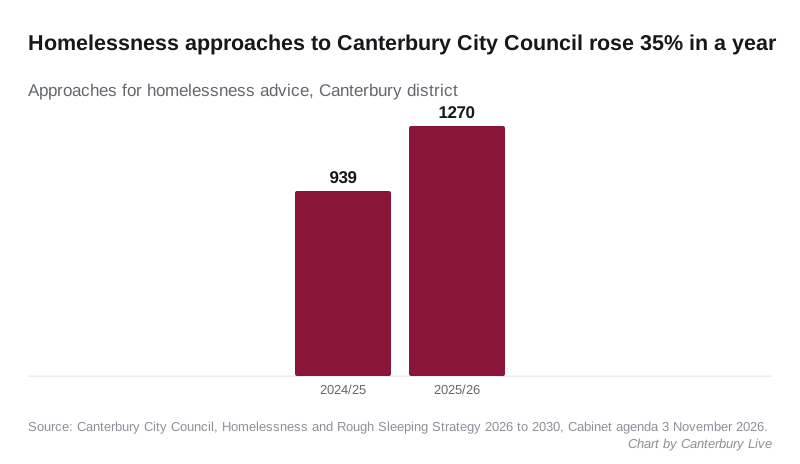
Homelessness approaches in the Canterbury district rose 35% in a year, to 1,270. The council's new strategy aims to halve rough sleeping by 2028.
The number of people asking Canterbury City Council for help because they were homeless or about to be rose by more than a third in a year. There were 939 approaches for homelessness advice in 2024/25 and 1,270 in 2025/26, an increase of 35%.
The figures are in the council’s new Homelessness and Rough Sleeping Strategy, which runs from 2026 to 2030. It went to the Cabinet for adoption on Tuesday 3 November. The written record of that meeting has not been published yet.
What the strategy says about the district
The strategy sets out the local picture in a few numbers:
- 1,270 approaches for homelessness advice in 2025/26, up from 939 the year before
- 160 households in temporary accommodation in September 2025, including 50 families with 123 children between them
- 116 households with support needs by March 2025, up from 71 a year earlier
- 55 young people aged 18 to 24 owed a homelessness duty by March 2025, up from 37
- 1,377 households on the social housing register in 2026, up from 1,356 in 2025
The three most common reasons people gave for approaching the council were the end of an assured shorthold tenancy, being asked to leave by family or friends, and domestic abuse.
The strategy says rough sleeping numbers in Canterbury “remain relatively low compared with national figures”. It counted 29 people sleeping rough on a single night and 21 sleeping rough long-term, both measured at September 2025.
The targets
Alongside the strategy sits an action plan, which the government requires every council to have in place by 1 December 2026. It sets yearly targets against a September 2025 baseline:
| Measure | September 2025 | Target for 2028 |
|---|---|---|
| People sleeping rough on a single night | 29 | Down 50% |
| People sleeping rough long-term | 21 | Down 50% |
| Homelessness prevented or relieved | 45% | 50% |
| Prevented or relieved, people facing multiple disadvantage | 23% | 37% |
| Families with children in temporary accommodation, per 1,000 households | 0.73 | Down 4% |
| Families with children in B&B for more than six weeks | 0 | 0 |
The halving targets for rough sleeping follow the government’s aim to halve it by the end of this Parliament, the plan says.
On families in temporary accommodation, the district already runs well below its neighbours. The plan puts the Kent average at 2.08 per 1,000 households and the South East at 2.45, against Canterbury’s 0.73.
What the council says it will do
The strategy has four priorities:
- prevent homelessness earlier, with targeted support
- reduce and prevent rough sleeping
- make advice and services easier to reach
- improve temporary accommodation and make better use of housing stock
Under the last of these, the council says it will buy more of its own temporary accommodation and rely less on private landlords. It also says it will limit the use of bed and breakfast and cut the number of households placed outside the district. It says it has already reduced its use of bed and breakfast since the last strategy.
It also plans to review its housing allocations policy. It will consider schemes to help social tenants with spare bedrooms move to smaller homes, freeing larger ones for families.
The strategy takes what it calls a child-centred approach, after a motion from Councillor Rachel Carnac. It means children’s schooling, health and support networks should count when families are placed, and time spent in temporary accommodation should be kept short.
What people told the council
The draft was open for consultation from 10 June to 2 September 2026. It drew 21 responses to the online survey. Twenty of the 21 strongly supported or supported each of the four priorities. Thirteen of the 21 said they were not sure what the early intervention approaches would involve.
When the council’s Overview Committee discussed the strategy on 8 October, councillors asked for more detail on who would deliver it and how it would be paid for and monitored. Several raised rural housing: the shortage of social rented homes in villages, and the decline of tied cottages for farm workers. Officers said the detailed action plan would set out responsibilities and dates.
A monthly Homelessness Delivery Group will oversee the work, the Cabinet report says.
What it means for you
- If you are worried about losing your home, contact the council as early as you can. The law counts you as threatened with homelessness from 56 days before you would lose your home, and the council has a duty to help from that point. The strategy makes earlier contact its first priority.
- If you rent privately, the end of a tenancy is the most common reason people in the district come to the council. A notice from your landlord is the point to ask for help, not the day you have to leave.
- If you are on the housing register, the strategy confirms the allocations policy will be reviewed. Any change to how homes are allocated would need its own decision.
Council housing rents are also due to rise next year; we reported the 2027/28 rent proposals last week. Council tax for this year is on our council tax bands page.
Have your say