
Charter Trustees would protect Canterbury's city status and Lord Mayor for 4p to 20p a week on council tax. Herne Bay gains a town council. Vote 16 September.
Canterbury will not get a town council. Instead, councillors are being asked to appoint Charter Trustees to hold on to the city’s status, its Lord Mayor and its Sheriff, paid for by a new charge on council tax bills in the city.
The council puts that charge at between 4p and 20p a week, with the final figure set by the trustees themselves (Canterbury City Council, 8 September 2026).
Herne Bay, meanwhile, is being offered a town council with 14 councillors. The Whitstable area is being offered three separate councils, for Tankerton, Whitstable and Seasalter.
All of it goes to the General Purposes Committee and then Full Council at the Guildhall on Wednesday 16 September, from 6pm. The 74-page report is public, and it says considerably more than the council’s press release does.
The area that most wanted a council is the one getting nothing
The council ran a first round of consultation from 7 May to 5 July. It drew 356 valid responses. Broken down by the three unparished areas, the pattern is striking:
| Area | Electorate | Responses | Support | Opposed |
|---|---|---|---|---|
| Canterbury | 28,864 | 84 | 75 (89%) | 4 (5%) |
| Herne Bay | 25,308 | 45 | 36 (80%) | 7 (16%) |
| Whitstable | 24,145 | 165 | 68 (41%) | 90 (55%) |
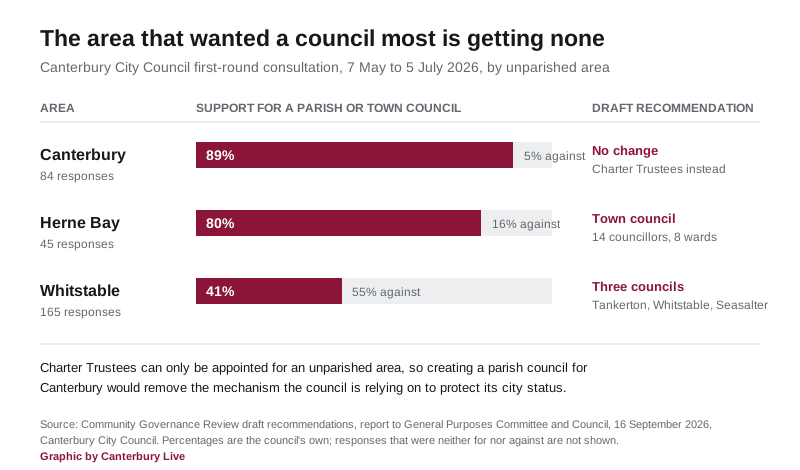
Canterbury returned the strongest support of the three and is the one area where the draft recommendation is “no change”. Whitstable returned a majority against and is being offered three councils.
The report is explicit about why Canterbury gets nothing, and it is not about the consultation. Charter Trustees can only be established for an unparished area. As the report puts it, if a parish council were created for Canterbury “before arrangements are in place to secure continuity of the city’s civic status and functions, the Charter Trustee option would no longer be available for that area”.
Creating a parish would close the door on the mechanism that protects city status. So the door stays shut on the parish.
Why the council thinks the status is at risk
Canterbury has been a city since time immemorial, which in law means before 1189. The report sets out the paper trail:
- 1448: Henry VI grants a city charter establishing the mayoralty
- 1461: Edward IV’s charter, with which the Sheriff of Canterbury is associated, gives Canterbury separate county status
- 1974: Letters Patent grant city status to Canterbury City Council for the entire district
- 1988: further Letters Patent make the Mayor of Canterbury a Lord Mayor
The 1974 grant is the problem. City status was attached to the district, and the district council was, until last week, due to be abolished on 1 April 2028 and folded into an East Kent unitary with Dover and Thanet.
The Ministry of Housing, Communities and Local Government told Kent chief executives in July that city status “is conferred by the Monarch and applies to a defined locality and arrangements need to be put in place to ensure that this status is preserved”. Where the council structure no longer matches the area originally granted the status, it said, Charter Trustees “are the usual legislative solution”.
The council took advice from a King’s Counsel. That advice is privileged and is not published, but the report summarises it: Charter Trustees are “the most reliable mechanism currently available”, and without one there is “a significant risk that continuity of those historic rights and dignities could not be assured”.
The report names the precedent it is trying not to repeat. Rochester lost city status during local government reorganisation in 1998 and has not regained it.
One alternative was considered and rejected on timing. Salisbury created a town council alongside new Letters Patent in 2009. The report calls that “legally possible but unlikely to be deliverable within the available timetable”, because it would need both MHCLG support and Royal action.
Charter Trustees would be drawn from already-elected councillors. The report suggests nine, from the proposed unitary wards of City North, City South and Canterbury South, covering the existing wards of Barton, Northgate, St Stephen’s, Westgate and the unparished part of Wincheap.
What each area is being offered
For Herne Bay, the draft recommendation is a new parish served by Herne Bay Town Council, with 14 councillors across eight wards: Bishopstone (1), Beltinge Village (1), Beacon Hill (2), Central (4), Eddington (1), Plenty Brook (1), Greenhill (2) and Studd Hill and Hampton (2). Plenty Brook moves across from Herne and Broomfield parish so that the whole development sits in one parish.
For the Whitstable area, the working group rejected a single town council in favour of three bodies:
- Tankerton Town Council, 8 councillors, split by the railway line into North Tankerton (6) and South Tankerton (2)
- Whitstable Community Council, 14 councillors, split by the railway into Harbour (6) and Gorrell (8)
- Seasalter Parish Council, 11 councillors, covering the area north of the A299
The report’s reasoning is that there was “less appetite for a single large town council to serve the whole area”, and that the distinct communities “may be better served with separate parishes”. Whitstable held its own governance review in 2024 and decided against a town council; 34 respondents this time said so, and the report records their frustration that “the consultation is ignoring the public’s prior decisions”.
The most common objection across the district was money. In Whitstable, 62 of the 165 responses raised the financial burden, pointing out that parish precepts are uncapped.
Eight existing parishes are also affected:
- Barham and Kingston grouped under one council, Barham 5 councillors and Kingston 2
- Blean extended to the A299 and split into Blean (6) and Yorkletts and Clapham Hill (3)
- Chestfield and Swalecliffe created as a new parish, Chestfield (8) and Swalecliffe (5)
- Chislet extended north to include Reculver, renamed Chislet and Reculver, and grouped with Hoath
- Fordwich and Sturry, a boundary change moving eight properties on the west side of Fordwich Road
- Herne and Broomfield, northern boundary moved to follow the A299
- Lower Hardres and Nackington, councillors increased to 7
- Thanington, wards removed, 9 councillors across an unwarded parish
The reorganisation behind all of this is now paused
On 7 September the government paused the entire local government reorganisation programme and put July’s decisions, Kent’s included, under review (letter to council leaders). Kent was paused rather than withdrawn. No date has been given for the outcome.
The council’s report acknowledges it. On parish elections it says that “in light of the Government announcement that the LGR timetable has been paused we cannot be certain when the MHCLG action will be taken to make the Structural Changes Order”.
That Order is the legal instrument creating the unitary councils, and the council now expects it in March 2027, having previously anticipated autumn 2026. The timing matters more than it sounds. Once the Order is made and the transitional period begins, the report says, Canterbury City Council loses the power to create parish councils, the successor authority does not yet exist to use it, and the joint committee of existing councillors does not have it. There is a window, and then there is not.
That is why the report asks councillors to bring the review’s completion date forward to 1 March 2027, with special meetings arranged for the purpose.
One number in the report has not been published before. The business case for the East Kent unitary was modelled on 66 councillors, of whom 24 would represent the Canterbury district. The district currently has 39 district councillors and eight county councillors. Our earlier report on the abolition plan and what the pause changes has the rest of the detail.
What it means for you
Nothing on your bill changes this year, and nothing changes at all if Full Council rejects the recommendations on 16 September. Our guide to council tax bands still stands as published.
If the recommendations are approved, four things follow.
A second consultation opens, this time on the specific proposals rather than open questions. Leaflets go to households where the proposals would materially change local governance. This is the round that matters: the report says final recommendations “will be based on the responses from local people far more acutely than the Draft Recommendations can”, and that where you disagree with a draft recommendation you are “encouraged to respond”.
A separate eight-week consultation opens for existing parish and town councils on moving their elections from May 2027 to May 2028, with a recommendation due to Council on 14 January 2027.
If you live in the unparished part of Canterbury, you would pay a Charter Trustee precept the council puts at 4p to 20p a week, and you would not get a town council. If you live in Herne Bay, Tankerton, Whitstable or Seasalter, you would get a new council with the power to set its own precept, which is not capped.
A reserve of £290,000 has been set aside to fund the review.
The meeting is at the Guildhall, St Peter’s Place, Canterbury, from 6pm on Wednesday 16 September. Members of the public may speak on any agenda item for up to three minutes, provided they tell Democratic Services by 12.30pm on the working day before.
Sources
- Community Governance Review draft recommendations, report to General Purposes Committee and Council, 16 September 2026 (Canterbury City Council)
- Agenda, General Purposes Committee, 16 September 2026 (Canterbury City Council)
- Protecting Canterbury’s city status is “top priority”, say councillors (Canterbury City Council, 8 September 2026)
- Local government reorganisation: programme review and decisions withdrawal, letter to council leaders, 7 September 2026 (Ministry of Housing, Communities and Local Government)
Have your say