
The plan to abolish Canterbury City Council on 1 April 2028 was paused on 7 September 2026. Here is what ministers had decided, and what is now back in doubt.
Updated 10 September 2026. This article was published on 22 August 2026, when the abolition of Canterbury City Council on 1 April 2028 was a settled government decision. On 7 September 2026 the government paused the whole reorganisation programme and put the July decisions, Kent’s included, under review. No date has been given for the outcome. Kent’s decision was paused, not withdrawn, so nothing below has been cancelled, but every date in it is now uncertain. The article has been rewritten into the past tense to reflect that. Our report on what the pause means locally is here.
Canterbury City Council was due to be abolished on 1 April 2028, with its area run by a new council called East Kent, covering Canterbury, Dover and Thanet, with 66 councillors. That timetable is now paused.
The three district councils have 127 councillors between them today. Kent County Council’s members for the area would have gone as well. The government set out the detail in a letter to Kent and Medway chief executives, dated 22 July 2026 (implementation letter). That letter is the substantive record. It carries decisions the council’s own announcement does not mention.
Canterbury City Council called the change “the biggest shake up of local authority arrangements in 50 years” when the decision was announced in July. It also stressed that “not one of our services will change overnight” (Canterbury City Council, 16 July 2026). That is accurate. The councils stay responsible for services until the day they are abolished.
What ministers have decided
The implementation letter confirmed four new unitary councils for Kent and Medway, replacing Kent County Council, Medway Council and 12 district, borough and city councils. All of the following is now subject to the review announced on 7 September. The decisions taken in July were:
- East Kent Council would cover Canterbury, Dover and Thanet, with 66 councillors
- The existing councils would be abolished on 1 April 2028
- Elections in May 2027 would replace any local elections otherwise scheduled that year
- Those elected in 2027 would serve most of their first year on a “shadow” council, preparing budgets and plans
- Each new council would adopt a Leader and Cabinet model, appoint statutory officers and adopt codes of conduct
- A Joint Committee for East Kent would have 12 members: six from the districts and six from the county council
The three other new councils were to be North Kent, at 81 councillors, West Kent at 84, and Mid Kent at 60.
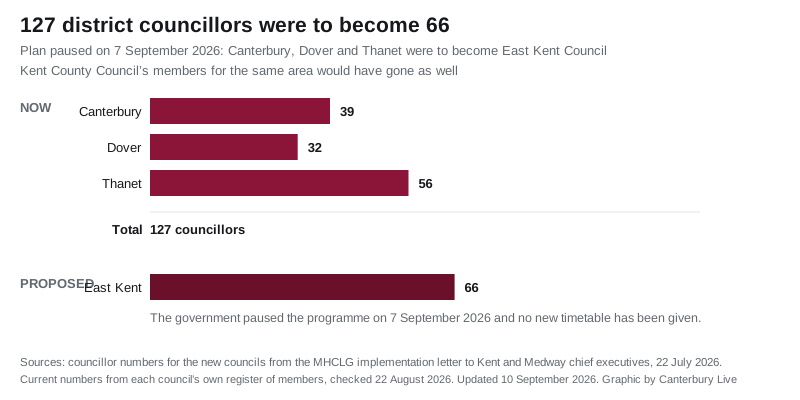
Canterbury City Council currently has 39 councillors (your councillors). Dover District Council states it “has 32 Councillors who are elected every four years” (Dover District Council). Thanet District Council says “there are currently 56 Councillors in total” (Thanet District Council).
Canterbury’s city status is a separate problem
This is the part that applies to Canterbury and to almost nowhere else in Kent.
The new council could not have been called a city council. Ministers ruled that “City” would not appear in any of the four legal names, because city status is granted by the Monarch and is not theirs to confer. The letter also rules out the “-ern” suffix, so “Eastern Kent” was never available, and bars dashes in council names.
City status itself does not disappear with the council. It is held by a defined locality rather than by an authority. But it does need protecting. The implementation letter is explicit that “arrangements need to be put in place to ensure that this status is preserved”, and that where the council structure no longer matches the area originally granted city status, Charter Trustees are “the usual legislative solution”. Charter Trustees can be established for unparished areas and can hold historic property, such as charters and insignia, on behalf of the whole area.
None of that is in place yet. The government says further legislation will follow the main Order, covering ceremonial matters “such as Lord Lieutenants or Charter Trustees”, and that it should come into force in time for 1 April 2028. Canterbury’s Lord Mayoralty and civic regalia sit inside that unfinished piece of work.
One route back to the name does exist. A new council may rename itself under section 74 of the Local Government Act 1972 if it calls a meeting for that purpose and two thirds of the members voting support it. Councils can also use a different name for branding without changing the legal one.
Why this option won
The Secretary of State chose the four unitary proposal submitted by Dover District Council, Swale Borough Council and Thanet District Council. Canterbury City Council was not one of the three that submitted it.
In the decision letter of 16 July, the Secretary of State said the chosen option “performed particularly well in supporting housing delivery, alignment with functional economic areas, public sector boundaries as well as place-based and locally responsive public services”. East Kent was described as having “growing sectors in health, life sciences and the creative economy and regeneration potential” (decision letter).
A rival plan for a single council covering all of Kent and Medway was rejected. Its population of over 1.9 million would have made it “by far the biggest council in the country”. The letter adds that the 500,000 population figure used throughout the process “has, however, always remained a guiding principle, not a fixed threshold”.
The money
The government has allocated £900,000 per new unitary council for transition costs, or £3.6m across Kent and Medway. It is to be paid by Section 31 grant during 2026/27, and normally to the council that employs the deputy implementation team leader for that area.
Separately, ministers committed up to £10m from an existing £63m capacity fund for children’s services, adult social care and public health leadership. That includes up to a further £150,000 per new unitary council.
The implementation team for all four councils will be led by Kent County Council’s Head of Paid Service. East Kent’s deputy team leader is to be agreed locally from one of the three district councils.
The dates that follow
- 17 August 2026: the deadline, now passed, for councils to supply returning officers, interim warding arrangements and parish election cycles, and to say which council should receive the grant. It was also the last window for unanimous representations on names and councillor numbers
- September 2026: the government expects to share the draft Structural Changes Order with councils for review and factual corrections
- 2027: the Order goes through the Joint Committee on Statutory Instruments, the Lords Secondary Legislation Scrutiny Committee, committee debates and approval motions in both Houses, then comes into force
- May 2027: elections to the new councils
- 1 April 2028: the existing councils abolished and East Kent Council takes over
7 September 2026 changed all of that. The Secretary of State paused the programme and put the July decisions under review. The council’s own report of 8 September now says the Structural Changes Order is expected in March 2027, having previously been anticipated in autumn 2026, and that following the pause “we cannot be certain when the MHCLG action will be taken to make the Structural Changes Order”.
Once the Order is in force, ministers expect to issue a direction under section 24 of the Local Government and Public Involvement in Health Act. It will require Canterbury, Dover and Thanet to get the shadow council’s consent before entering into certain contracts or disposing of certain assets.
What it means for you
Nothing changes for your bins, your council tax bill or a planning application. That was true before the pause and it is more true after it. The council you deal with today is the council you will deal with next year. Our guides to bin collection days, council tax bands and planning applications all still apply.
Three things are worth watching.
The first is warding. Canterbury’s suggested interim ward boundaries went to the government on 17 August and will be written into the Order. They can be built from existing district wards, county divisions or parishes, but not from polling districts. The Local Government Boundary Commission for England will run a full review afterwards, before the elections after 2027.
The second is the May 2027 election. Under the July decision you would have been voting for East Kent Council rather than for Canterbury City Council. The government’s pause letter says polls in May 2027 go ahead to existing council boundaries, so that is in doubt too. Registering to vote still runs through the current council, which is why this summer’s annual canvass letters still matter.
The third is city status. It is not lost automatically, but it is not settled either, and the mechanism for keeping it has not yet been legislated.
Sources
- Local government reorganisation: implementation letter to Kent and Medway chief executives, 22 July 2026 (Ministry of Housing, Communities and Local Government)
- Local government reorganisation: decision letter to Kent and Medway council leaders, 16 July 2026
- Kent and Medway local government reorganisation (GOV.UK collection)
- Ministers decide future shape of Kent and Medway’s councils (Canterbury City Council, 16 July 2026)
- Local government reorganisation: programme review and decisions withdrawal, letter to council leaders, 7 September 2026 (Ministry of Housing, Communities and Local Government)
- Community Governance Review draft recommendations, report to General Purposes Committee and Council, 16 September 2026 (Canterbury City Council)
- Councillor numbers taken from each council’s own register of members: Canterbury, Dover, Thanet, checked 22 August 2026
Have your say