
The council's draft drops its core hours policy and all eight appendices, and 281 of its 306 sentences match Dover's. Consultation closes 17 November.
Canterbury City Council is asking residents and businesses what they think of a new licensing policy. It opened the consultation on 22 September and it closes at 9am on Tuesday 17 November.
The document people are being asked to comment on is not much like the one it would replace. We read both. The policy the council adopted in February 2022 runs to 110 pages, with 20 numbered sections and eight appendices. The draft published last week runs to 23 pages and has six sections and no appendices.
The parts that are gone are the local ones.
What the draft leaves out
Comparing the draft against the adopted 2022 policy, these are missing:
- The core hours policy. The phrase “core hours” appears six times in the adopted policy and not once in the draft.
- Section 20, “Key local issues”. This is the Canterbury-specific chapter: late-night transport and dispersal, nightclubs, the licensing forum, the Spike drink-spiking campaign and the District Watch scheme.
- All eight appendices, including the code of practice, the full risk assessment template, the enforcement options and the table showing which licensing decisions are taken by officers and which by councillors. The draft still refers to a published scheme of delegation, but does not print it. That matters more than it sounds: in May the Licensing Committee set up this year’s Licensing Sub-Committee by resolving that its functions be discharged “in accordance with the Scheme of Delegation set out at Appendix G of the Council’s Licensing Policy (determined on 22 February 2022)” (minutes, item 28).
- The evidence base. The adopted policy sets out the district’s population, its area in hectares, its four universities and its count of licensed premises, then uses those facts to justify what it does. None of that is in the draft. The words “university” and “student” do not appear in it at all.
- The late night levy, mentioned once in the adopted policy and not in the draft.
The core hours, and why they matter
Core hours are the times a licence will normally be granted for. They are not a curfew. They set the point beyond which an applicant has to argue their case.
The adopted policy lists them in full. For premises selling alcohol to be drunk on site:
| Type of premises | Mon to Thu | Fri and Sat | Sunday |
|---|---|---|---|
| Alcohol, on the premises | 10:00 to 23:30 | 10:00 to 00:00 | 12:00 to 23:30 |
| Alcohol, off the premises | 08:00 to 23:00 (Mon to Sat) | 08:00 to 23:00 | 10:00 to 22:30 |
| Other licensable activities | 09:00 to 23:30 | 09:00 to 00:00 | 09:00 to 23:30 |
On Sundays immediately before a bank holiday, the adopted policy pushes the alcohol and other-activity closing times to midnight.
The adopted policy is blunt about why the council wrote them down. It records “over 800 premises” in the district, says the night-time economy had grown by “a continual creeping extension”, and describes premises “regularly extending the opening hours with a piece-meal strategy of applying for an extra 30 to 60 minutes every 12 to 18 months”. It then sets the hours against residents’ rights to “quiet enjoyment of their homes” and to “sufficient sleep”.
It is also explicit that fixed hours would not touch anybody already trading. They “will only affect new premises licence applications, applications to vary existing licences beyond their current / core hours and those premises subjected to a review application”.
The draft takes the opposite starting point. At paragraph 1.16 it says: “Longer licensing hours with regard to the sale of alcohol are an important strategy to ensure that the concentration of customers leaving premises simultaneously is avoided.”
At paragraph 5.3 it goes further:
Applicants need to clearly understand that the Licensing Authority will not normally look to imposing stricter conditions, including controls on licensing hours, where licensed premises are in residential areas. It is the view of Canterbury City Council that all parts of the City are to be considered residential areas to some degree and that no stricter conditions would be imposed in residential areas.
Most of the draft is Dover’s policy
The file the council has published is called
FINAL-Published-Licensing-Policy-2022-2027-Copy.pdf. That is the file name of
Dover District Council’s published licensing policy,
with the word “Copy” added. Inside, the PDF’s document properties give the
subject as “Dover District Council’s Licensing Policy” and name the same author
as Dover’s file.
The text matches too. Dover’s policy, approved in January 2022, has the same six sections in the same order. We compared the two documents sentence by sentence, counting a sentence as matching if it was identical once “Canterbury City Council” was swapped for “Dover District Council” and “City” for “District”. 281 of the 306 sentences in Canterbury’s draft appear in Dover’s policy.
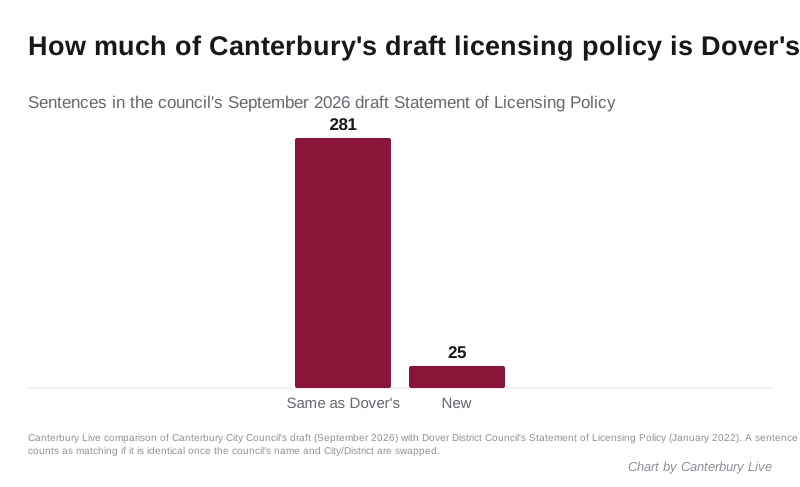
The 25 sentences that are not Dover’s are worth reading, because they are the additions:
- a paragraph on the council working towards White Ribbon accreditation
- a paragraph reminding licence holders that assistance dogs are not pets, and that refusing entry may be unlawful discrimination
- a new section 4.5 on women’s safety, expecting premises to know the Ask for Angela scheme and to have evidence of it in staff training records, to train staff as active bystanders, to display anti-spiking posters, to provide free anti-spiking devices and to offer free drinking water
- a paragraph on Martyn’s Law and terrorism preparedness
- references to the City Watch Radio scheme and to training offered by Canterbury BID and the council’s Community Safety Unit
- digital CCTV to a standard approved by Kent Police
- the 499-person cap on an event covered by a temporary event notice
- a line confirming there are no early morning alcohol restriction orders in the district
Those are real additions, and the women’s safety section is the most substantial new material in the document.
What the council told its own committee
On 6 July the licensing team gave its annual report to the council’s Licensing Committee. Under the heading “Premises Licence Policy update”, it said this:
The Policy is proposed to be largely the same in format and content to the current adopted policy. We intend to include a small update regarding accessibility and guide dogs and a section promoting the White Ribbon initiative.
The guide dogs paragraph and the White Ribbon paragraph both arrived as promised. The rest did not. The same report confirms the district now has 1,116 licensed premises, against the “over 800” recorded in the 2022 policy, and that the adopted policy “is valid until 2027” (report, item 162).
The Licensing Committee met three times in 2026, on 20 April, 18 May and 6 July. No report on the draft policy appears on any of those published agendas, and 6 July was its last published meeting.
On cumulative impact, both documents say the same thing
Neither the adopted policy nor the draft creates a cumulative impact area, and the district has never had one. The difference is how much is said about it.
The adopted policy gives the subject its own section, sets out the evidence and consultation a special policy would need, explains the “red routes” that pedestrians use between venues, and says cumulative impact areas would be handled separately from the policy review so the council is never left without a policy. The draft covers it in two paragraphs and records that “there are currently no cumulative impact areas within Canterbury City”.
What it means for you
If you run a licensed business, the draft is friendlier to you than the policy it replaces, and the difference is concentrated in one place: hours. Without core hours there is no published line to argue past, and paragraph 5.3 says the council will not normally impose stricter conditions because a premises sits among houses.
If you live near licensed premises, the same paragraph is the one to read. The adopted policy’s reasoning about sleep, dispersal and creeping extensions is not in the draft, and neither are the practical local schemes listed in section 20.
Either way, the consultation is the moment to say so. Question 4 on the survey asks directly: “Is there anything you expected to see in the draft policy that is not included?”
How to respond
- Deadline: 9am on Tuesday 17 November 2026.
- Complete the council’s online survey, or download the paper version to see the questions first or to reply by post.
- Email consultations@canterbury.gov.uk, or phone 01227 862000 between 8.45am and 5pm on weekdays.
- Write to: Consultations team, Canterbury City Council, 14 Rose Lane, Canterbury, CT1 2UR.
- A paper copy of the draft can be read at 14 Rose Lane during office hours.
Licensing and planning are separate systems, and a licence is not permission to build or change the use of a building. If it is the building work you want to follow, our guide to Canterbury planning applications explains how to search the register and comment.
Frequently asked questions
When does the Canterbury licensing policy consultation close?
At 9am on Tuesday 17 November 2026. Responses go in through the council’s online survey, by email to consultations@canterbury.gov.uk, or by post to the Consultations team at 14 Rose Lane, Canterbury, CT1 2UR.
What are Canterbury’s core hours for licensed premises?
Under the policy adopted in February 2022, premises selling alcohol for drinking on site have core hours of 10:00 to 23:30 Monday to Thursday, 10:00 to midnight on Friday and Saturday, and 12:00 to 23:30 on Sunday. Off-sales are 08:00 to 23:00 Monday to Saturday and 10:00 to 22:30 on Sunday. The September 2026 draft contains no core hours.
Would the draft policy change the hours of pubs that are already open?
No. The adopted policy is explicit that fixed hours bite only on new applications, on variations that go beyond a premises’ current hours, and on premises subject to a review. A statement of licensing policy does not alter existing licences.
How many licensed premises are there in the Canterbury district?
1,116, according to the council’s licensing report to the Licensing Committee on 6 July 2026. The 2022 policy recorded “over 800”.
Does Canterbury have a cumulative impact area?
No. Both the adopted policy and the draft record that there are none in the district. Adopting one would need its own evidence base and its own consultation.
Sources
- Canterbury City Council: Draft Licensing Policy consultation, published 22 September 2026, for the consultation dates, the aims of the draft and the ways to respond.
- The draft Statement of Licensing Policy, September 2026, the document linked from that page, for paragraphs 1.16, 1.23, 1.24, 1.32, 4.5, 4.6 and 5.3 and for its structure, length and document properties.
- Canterbury City Council’s Statement of Licensing Policy, adopted 22 February 2022, for the core hours at paragraph 11.4, the reasons at 11.5, section 10 on cumulative impact, section 20 on key local issues and appendices A to H.
- Dover District Council’s Statement of Licensing Policy, January 2022, for the comparison.
- Canterbury City Council licensing report to the Licensing Committee, 6 July 2026, item 162, for the 1,116 licensed premises, the validity of the current policy and the “largely the same in format and content” line.
- Canterbury City Council Licensing Committee minutes of 18 May 2026, 20 April 2026 and 6 July 2026, for the Appendix G resolution and for the absence of any item on the draft policy.
- The consultation survey, paper version, for the questions asked.
Have your say