
Canterbury's general fund landed within £16,000 of budget, and next year's plan needs no reserve top-up, the first since 2020. Scrutiny hears it on 2 September.
Canterbury City Council spent its 2025/26 general fund to within £16,000 of the budget it set in February 2025. On a council of this size that is close to exact.
The figure appears in the financial outturn report going before the council’s Scrutiny Committee at the Guildhall on Wednesday 2 September, written by Nicci Mills, the Director of Finance and Procurement and the council’s section 151 officer.
The more consequential line is further down. For 2026/27 the council’s Medium-Term Financial Strategy “assessed no requirement to take from the budget stabilisation reserve”, and the report says that is the first time since 2020. In 2025/26 the council planned to take £0.4m from that reserve to balance the books, and did.
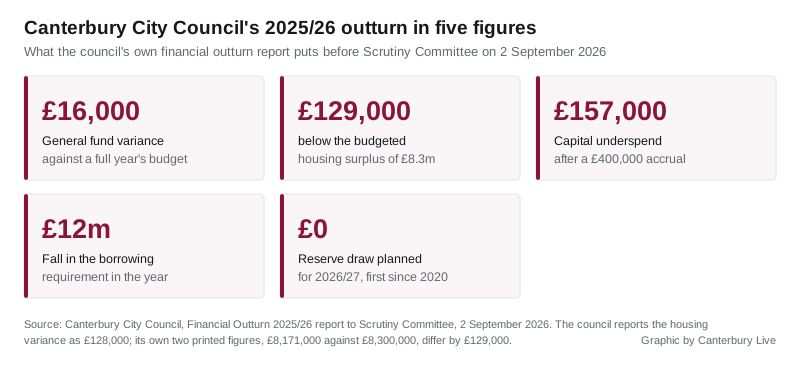
Where the year actually landed
Four numbers carry the outturn:
- General fund: a revenue variance of £16,000 against budget.
- Housing Revenue Account: a surplus of £8,171,000, against a budgeted surplus of £8,300,000.
- Capital programme: an underspend first reported at £557,000, revised down to £157,000. A £400,000 computer development underspend has since been accrued because the grant money is being spent in 2026/27 instead. What is left relates to the leisure centre refurbishments completed early in 2025/26.
- Borrowing: the Capital Financing Requirement, which measures the underlying need to borrow, fell by £12m between 31 March 2025 and 31 March 2026, per the Treasury Outturn Report that went to Audit Committee in July.
One line in the report does not add up. It describes the housing account position as “a surplus of £128,000 made up from a surplus of £8,171,000, compared to a budgeted surplus of £8,300,000”. Those two printed figures differ by £129,000 rather than £128,000, which rounding of the underlying numbers would explain. The wording is the bigger problem: the housing account came in £129,000 below its budgeted surplus, not above it.
The pressures the council says it cannot control
The report is candid about what pushed against the budget, and none of it is unique to Canterbury.
Housing Benefit is named as “a particularly significant pressure”, with spending over budget because of rising claims tied to supported and temporary accommodation. The report points at the gap between the subsidy the government pays and what the benefit actually costs. It calls continued growth in temporary accommodation “a further financial risk”, because the council has a statutory duty to house eligible households while “government funding mechanisms do not fully reimburse the associated costs”.
The former Military Road offices. The council moved out, and is still paying. The outturn carries extra spending on business rates, security and other property costs for retaining the building after the relocation. The report calls this a temporary overspend expected to conclude during the current financial year.
Borrowing costs. Interest rates have come down more slowly than the council budgeted for, and it borrowed more to fund the capital programme. The two together pushed treasury costs over budget. The council says it will swap short-term borrowing for longer-term arrangements as rates fall.
On reserves, the report is blunt: relying on them to absorb “demand-led and externally generated financial pressures is not sustainable over the longer term”.
What happens next
The 2025/26 outturn already went to Cabinet on 30 June. What Scrutiny Committee gets on 2 September is the annual deep dive into finance, projects and performance, alongside the council’s Annual Impact Report for 2025/26.
The draft Statement of Accounts is on the council’s website. The external auditor is Grant Thornton, and the report says it is “due to start the 2025/26 audit next month”.
What it means for you: the headline is reassuring and the detail is not quite. The council managed a difficult year to within £16,000 on its main budget, and has planned a 2026/27 that does not lean on the stabilisation reserve for the first time in six years. But the costs that ran over are the ones it cannot switch off: housing benefit subsidy shortfalls, temporary accommodation and interest. Those are the same pressures that decide whether your council tax bill rises again next February, and they are the ones worth asking about.
You can go and ask. The Scrutiny Committee meets at 7pm on Wednesday 2 September at the Guildhall, St Peter’s Place. Members of the public may speak on any agenda item for up to three minutes, provided Democratic Services is told by 12.30pm on the working day before, which for this meeting means Tuesday 1 September. The contact is democracy@canterbury.gov.uk or 01227 862 009. The next meeting after that is not until 25 November.
Sources
- Canterbury City Council, Scrutiny Committee agenda for 2 September 2026, including the Financial Outturn 2025/26 report by Nicci Mills, Director of Finance and Procurement, for every figure above.
- The same agenda for the meeting’s time, venue, public speaking rules and the date of the next meeting.
- Treasury Outturn Report to Audit Committee, July 2026, as cited in the outturn report, for the £12m reduction in the Capital Financing Requirement.
Have your say