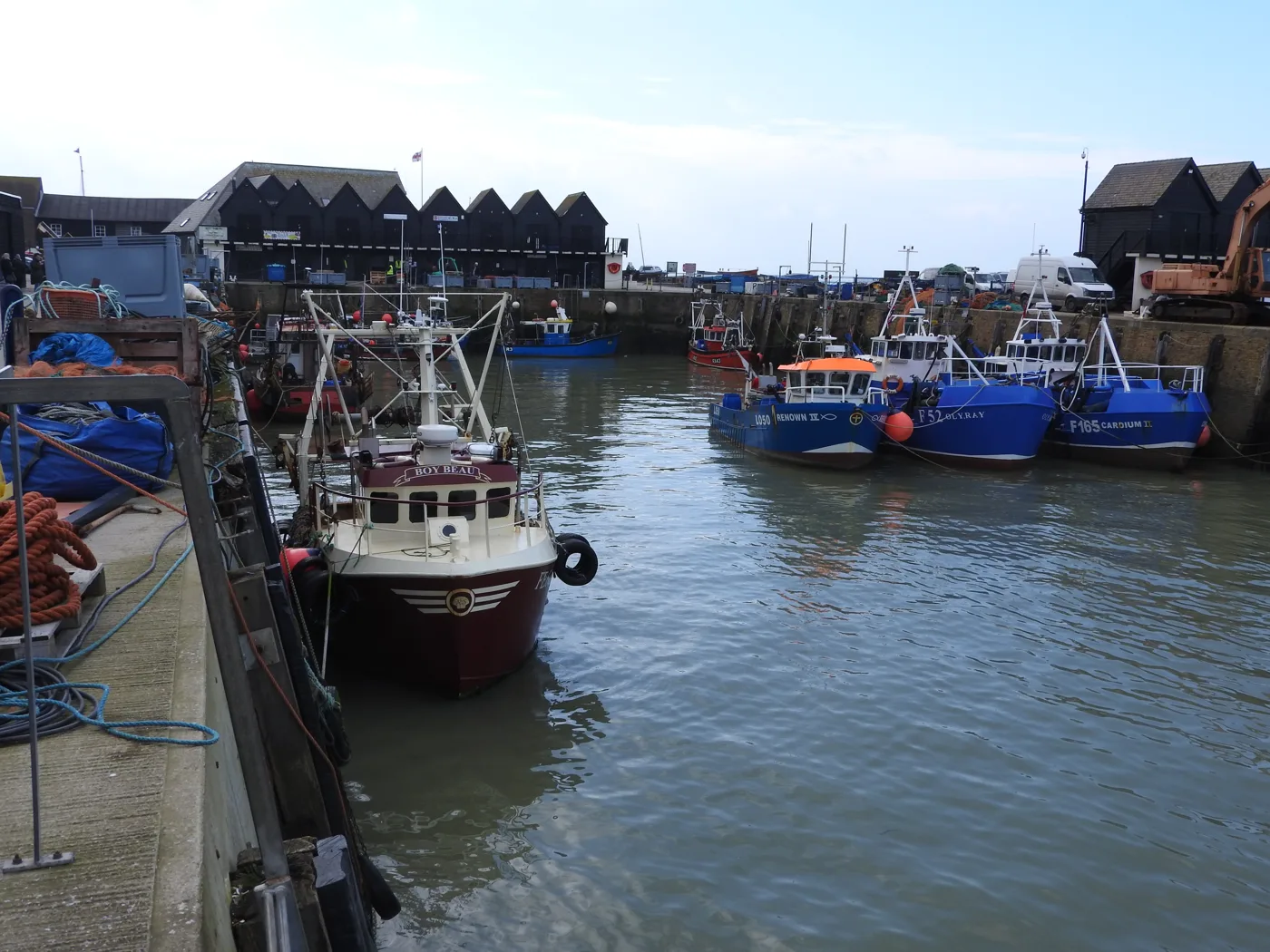

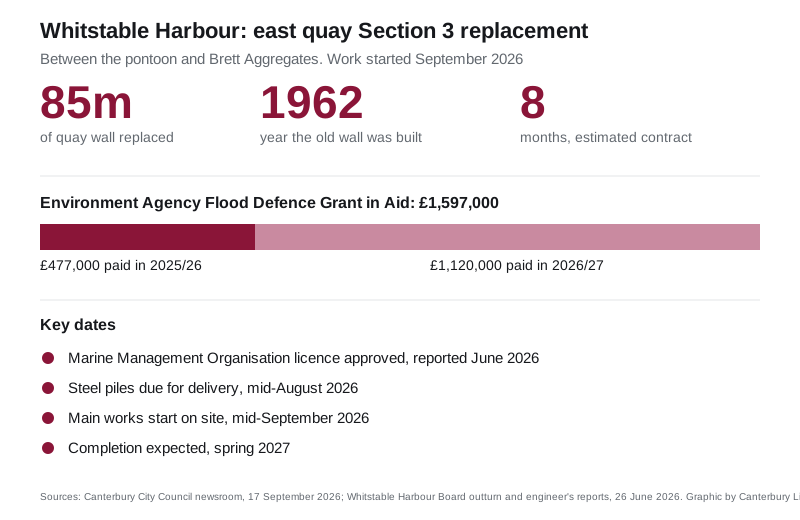
Work has started on 85 metres of Whitstable Harbour's east quay, where the 1962 steel piles have corroded through. The Environment Agency is paying £1,597,000.
Work to replace an 85-metre stretch of Whitstable Harbour’s east quay has started, in a scheme the city council says will protect the harbour and the town from coastal flooding. The council announced the start on 17 September.
The section runs between the pontoon and Brett Aggregates. It was built in 1962. After more than 60 years in seawater the steel sheet piles have corroded and reached the end of their working life.
The council puts the cost at about £1.6 million and names Ovenden Allworks as the contractor. It expects the work to finish in spring 2027, with the programme set for the winter months to limit disruption to pontoon operators and other harbour users.
The Environment Agency is paying £1,597,000
The council’s press release says the project is funded by the Environment Agency. The exact figure and the payment schedule are in the harbour’s own accounts.
The annual outturn report to Whitstable Harbour Board on 26 June records that the Environment Agency approved the business case for Flood Defence Grant in Aid capital funding. It sets out:
- £1,597,000 approved in total for the project
- £477,000 paid in 2025/26
- £1,120,000 paid in 2026/27
- both payments already claimed by the harbour
The report calls this stretch “Section 3”, one of the numbered sections the harbour has divided its quay walls into on its own plan. The harbour’s own capital budget for 2025/26 was £56,000, of which £52,000 was spent, so the grant is roughly 30 times the harbour’s annual capital spending.
What the contractors are actually doing
The method is unusual, and it is the reason the quay will look much the same afterwards. Rather than pulling out the old wall, the new one goes in front of it:
- the existing concrete coping is removed
- a new steel quay wall is driven in front of the existing structure
- the gap between the old and new walls is filled
- the quay surface is lifted so a new anchor beam and tie rods can be installed behind the new wall
- the surface and the concrete coping are then rebuilt
The engineer’s report to the same June meeting confirms three things that had to fall into place first:
- the Marine Management Organisation licence for the marine elements was approved
- tenders for the steel piles and for the works came in within budget
- the piles were due for delivery in mid-August
That report gave the estimated contract duration as eight months from a mid-September start, which would run to mid-May 2027, and said officers were working with the principal contractor to shorten it. The council’s “spring 2027” is the same date, expressed more kindly.
The Gamecock has already moved out
Preparations have been visible around the harbour for months.
The vessel Gamecock, under restoration by Whitstable Maritime, was moved to Iron Wharf in Faversham so that work on the boat could continue away from the quay. The engineer’s report records the move as a consequence of the quay scheduling.
Enabling work also freed up storage space in the Fishermen’s Compound on the west quay, which the harbour says allowed the last berth holder waiting for storage to be offered it.
Separately, the same report records that improvements to the floodgates along the Whitstable frontage are substantially complete. Floodgate W5, near the Old Neptune, is now a double swing gate, and floodgate W8 at the Horsebridge is a sliding gate. Both replace heavy drop timber gates, which the harbour says lets the gates be left open for longer and improves access to the seafront.
What it means for you
The harbour stays open. What changes is the look and the noise of it.
Cllr Chris Cornell, chairman of Whitstable Harbour Board, said in the council’s announcement: “Over the next few months, visitors to the harbour will notice lots of activity and a few changes along the east quay, before it all gets back to normal in time for the 2027 season.”
He added: “Work like this can be noisy and we are sure the piling and big machinery will attract some attention, but we thank everyone in advance for their patience, understanding and cooperation.”
Piling is the loud part, and it is scheduled through the winter rather than the summer for that reason. There is a second thing to know if you are heading to the harbour. Sea Street is due to close from 21 September for a separate sewer scheme, which reverses the one-way system on Harbour Street. Our Canterbury roadworks and travel page is updated through the week.
The flood case is the reason the Environment Agency is paying. A failing quay wall is not only a harbour problem: the wall is part of the defence line for the town behind it. The harbour’s papers treat the Section 3 replacement and the floodgate works as parts of the same frontage.
The next Whitstable Harbour Board meeting is on 9 October 2026, when the engineer is due to report on progress. Agendas appear on the council’s democracy pages.
Have your say