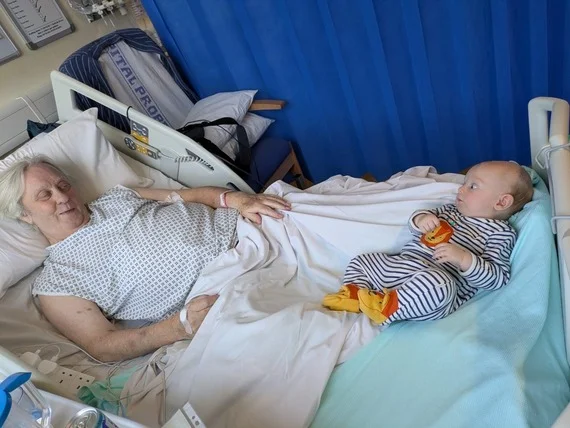

Nigel Sanné, 69, from Sturry survived sepsis, an allergic reaction and Kounis syndrome. He thanks the William Harvey Hospital consultant who spotted it.
Nigel Sanné, a 69-year-old retired teacher from Sturry, has thanked staff at the William Harvey Hospital in Ashford after surviving sepsis, a near-fatal allergic reaction and a rare heart condition called Kounis syndrome during a month in their care.
He gives most of the credit to one decision. Critical care consultant Dr Prashant Parulekar recognised Kounis syndrome, which East Kent Hospitals describes as a very rare, easily missed condition that causes severe spasms in the coronary arteries.
“That moment the consultant diagnosed Kounis syndrome under intense pressure, that is the reason I am here today,” Nigel said.
Overview
- Who: Nigel Sanné, 69, a grandfather and retired teacher from Sturry.
- Where: the William Harvey Hospital in Ashford, with specialists in London and Birmingham.
- What happened: complications after complex abdominal reconstruction surgery in London led to sepsis, an allergic reaction to the antibiotics, Kounis syndrome and then immune thrombocytopenia.
- How long: 10 days in critical care and a further three weeks on a ward. He is now recovering at home.
How it unfolded
Nigel developed complications after complex abdominal reconstruction surgery in London. While he was being treated for sepsis at the William Harvey, he had an allergic reaction to the antibiotics. According to the trust, that triggered a cardiac crash which mirrored a heart attack, but the standard treatment was not working and his condition kept getting worse.
That was when Dr Parulekar recalled the medical literature on Kounis syndrome. Teams in Kent, London and Birmingham then worked together to pull him through.
“The NHS gets a lot of negative publicity, but my story is living proof of what it is truly capable of when faced with seemingly overwhelming odds,” Nigel said.
“It wasn’t just one doctor or one department; it was a massive, synchronised effort.
“Every single link in the chain had to be perfect to keep me alive.
“From the incredible nurses on the floor at the William Harvey to the experts they emailed in London and Birmingham, the sheer cooperation across so many disciplines and cities was staggering.”
A blood product sent across London by bike
After 10 days in critical care Nigel moved to a ward for three weeks, where he faced another complication: immune thrombocytopenia, which left the platelet levels in his blood dangerously low. He needed an infusion made for him, which was ordered and delivered from the other side of London within two hours.
“There are only three places in the UK that can produce a blood-type matched platelet enriched blood product to help combat this,” he said.
“Within two hours a solution had been custom created and transferred from the other side of London, via bike courier, to be transfused into me.
“It was the haematology department at St Thomas’s and at William Harvey that saved me this time by temporarily suppressing my immune system with a ‘steroid bomb’, 10 times the normal dose, three times a day over four days.
“Luckily my count recovered and the danger passed within 24 hours. That was the fourth attempt to kill me off and I was so lucky to have come through it.”
‘Don’t worry, we have you safe’
Nigel and his wife are devoted Marillion fans, and he said one of the band’s songs stayed with him throughout.
“I kept thinking all the way through my ordeal of the refrain from one of their songs written during the pandemic. It was called ‘Care’ and refers to our dedicated NHS staff. It quotes ‘The angels of this world are not on the walls of churches’.”
He remembers the worst moments clearly.
“I bottomed out twice, my poor wife was there and I remember her shouting ‘please don’t leave me’,” he said.
“But all the way through the team were so caring and reassuring. Someone was holding my hand and they said ‘don’t worry, we have you safe’. And they did.
“It was probably just another day at work for that consultant, but his knowledge saved my life, and that has had an impact on all the people around me; my children and grandchildren, my wife, my friends, and the charities I work with.
“There were a whole set of unrelated, awful catastrophes, any one of which could have been fatal, and his skill and the whole hospital team’s work prevented that. It feels like a miracle.”
“This story needs to be told because it shows the absolute peak of British healthcare,” he added.
The William Harvey is one of five hospitals run by East Kent Hospitals University NHS Foundation Trust, alongside the Kent and Canterbury Hospital, and it is home to the trust’s cardiac service for the whole of Kent.
Source: East Kent Hospitals University NHS Foundation Trust.
Have your say