
Canterbury's new Local Plan goes to ministers in September 2026: 1,215 homes a year, the big allocated sites, the Bodkin Farm approval and how to have your say.
The biggest planning story in the Canterbury district is not any single estate. It is the new Canterbury District Local Plan, the document that decides where more than 20,000 homes can be built across Canterbury, Whitstable, Herne Bay and the villages through 2042/43, and it is about to leave the council’s hands: submission to the Government for independent examination is expected in September 2026. Here is where the plan stands, the sites it allocates, the decisions already landing ahead of it, and how to track and comment on applications near you.
Where the Local Plan stands
The plan the district currently lives under was adopted back in 2017. Its replacement has been through two false starts, a “Local Plan to 2045” draft consulted in 2022-23 under the previous administration and a reworked “to 2040” draft in 2024, before reaching its final shape this spring:
- 18 March 2026: Full Council approved the final draft, the Regulation 19 version, for publication (Canterbury City Council).
- 18 May 2026: the Regulation 19 consultation closed. This was the formal “soundness” stage, where comments go to the inspector rather than the council.
- September 2026 (expected): the council submits the plan, with every representation received, to the Secretary of State. A Planning Inspector is then appointed to run the examination (Canterbury City Council).
The driving number is the Government-set target of 1,215 new homes a year through 2042/43 (council announcement), which the plan meets by allocating land for more than 23,000 homes, alongside 2,329 affordable homes, 721 homes for older people and 169 hectares of open space (KentOnline).
Where the homes would go
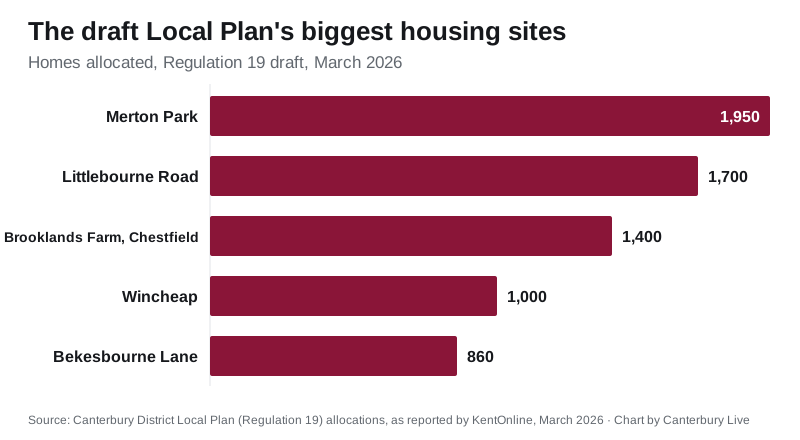
The largest allocations in the final draft, as reported when it was published (KentOnline):
- Canterbury: Merton Park (1,950 homes), land south of Littlebourne Road (1,700), Wincheap (1,000), south of Bekesbourne Lane (860) and the former council offices on Military Road (180).
- Whitstable: Brooklands Farm, Chestfield (1,400), Bodkin Farm (250) and south of Thanet Way (220).
- Herne Bay: Home Farm and Strode Park (200) and west of Thornden Wood Road (150).
- Villages: The Hill, Littlebourne (300) and Chartham Paper Mill (165).
Just as telling is what came out. The final draft dropped earlier proposals for 2,000 homes north of the University of Kent campus near Blean and a 3,200-home settlement near Adisham (KentOnline).
What it means for you: an allocation is not a planning permission, but once the plan is adopted it makes a later detailed application on that land very hard to refuse. The soundness comments are in and the argument now happens at examination, in public hearings run by the inspector. If your area is on the list above, the examination timetable on the council’s new Local Plan hub is the thing to watch. Land supply on this scale also feeds directly into what homes cost here.
Decisions already landing: Bodkin Farm and Mountfield Park
The plan’s direction is already visible in committee decisions. In July 2026 the council’s planning committee approved the Bodkin Farm scheme at Chestfield: 300 homes, a secondary school with sixth form, a 24-unit care home, sports facilities and shops on 65 acres between Whitstable and Herne Bay. The site sits in a protected Green Gap under the current rules but is allocated in the draft plan; the committee had deferred it in May over wastewater and transport concerns before passing it five votes to none, with three abstentions, against 75 objections (KentOnline).
Meanwhile the district’s biggest consented scheme is finally moving. Mountfield Park, the 4,000-home urban extension south of Canterbury approved in December 2022, now has a construction timeline: archaeological investigation in 2026, infrastructure work in 2027, housebuilding from 2028 with first completions expected in 2029. The 550-acre scheme, coordinated by master developer Gummer Leathes for Corinthian Land, includes two primary schools, a health centre and 70,000 square metres of employment space (KentOnline).
Transport: the plan that replaced the “circulation plan”
Planning this much growth revived the question that convulsed the city in 2022: the draft “Canterbury Circulation Plan”, which would have divided the city into five ANPR-enforced traffic zones. That scheme was scrapped in 2023 by the incoming administration (KentOnline). Its successor, the Draft Canterbury District Transport Strategy, was consulted alongside the Local Plan this spring: a roughly 15-year, £18m programme of bus and cycle priority, ring-road junction changes and a Crab and Winkle route extension, with critics calling it “hostile to drivers” (KentOnline). How the road network copes day to day is covered in our roadworks and travel page.
How to track and comment on applications
Applications keep being decided under the current rules while the new plan is examined. Three tools cover everything:
- The council’s search and comment page explains how to find, comment on, object to and track any application.
- The Public Access portal holds the documents for every live and historic case, with weekly lists of everything newly validated and decided.
- Our own planning applications page explains the process, deadlines and what counts as a valid objection.
Frequently asked questions
What is the housing target for the Canterbury district?
1,215 homes a year through 2042/43, set by the Government’s standard method. The new Local Plan allocates land for more than 23,000 homes to meet it (Canterbury City Council, KentOnline).
Has the new Canterbury Local Plan been adopted?
No. The Regulation 19 consultation closed on 18 May 2026 and the council expects to submit the plan for independent examination in September 2026. Until adoption, the 2017 Local Plan remains the development plan for decisions.
Is the Canterbury traffic zones plan still happening?
No. The 2022 “circulation plan” with its five ANPR-enforced zones was scrapped in 2023. The current proposal is the milder Draft District Transport Strategy, consulted in spring 2026.
How do I object to a planning application in Canterbury?
Find the application on the Public Access portal and submit your comments within the consultation window; the council’s guidance page explains what carries weight. Our planning applications explainer walks through the process.
Sources
- Canterbury City Council: Regulation 19 consultation for the plan timeline and September submission.
- Canterbury City Council: final draft announcement for the 1,215 homes-a-year target.
- Canterbury City Council: new Local Plan hub and the adopted 2017 plan.
- KentOnline: final draft approved, where 23,000 homes could go, Bodkin Farm approval, Mountfield Park timeline, circulation plan scrapped and the transport strategy.
We will update this page when the plan is formally submitted and the examination timetable is published.
Have your say