
Canterbury approved five blue plaques on 1 and 3 September: a rebel whose head went on the Westgate, a medieval financier, the home of the Canterbury Scene.
Canterbury is getting a plaque to a rebel whose head ended up on a spike above the Westgate. Canterbury City Council granted listed building consent on 1 and 3 September for five new blue plaques in the city centre, part of a run of 21 the Canterbury Commemoration Society wants in place by early 2027.
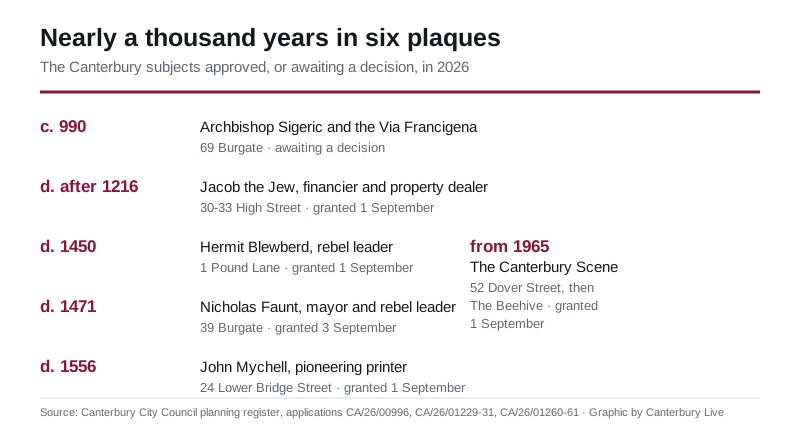
The five approved, with the wording as submitted:
| Where | Who or what | On the plaque |
|---|---|---|
| 1 Pound Lane | Hermit Blewberd, aka Thomas Cheyne, d.1450 | “Rebel leader … captured at Canterbury, executed in London, head displayed on a spike atop the Westgate nearby” |
| 39 Burgate | Nicholas Faunt, d.1471 | “Canterbury mayor and rebel leader … captured at Blackheath, returned to Canterbury, executed nearby in the Buttermarket (Bulstake)” |
| 24 Lower Bridge Street | John Mychell, d.1556 | “On this site the pioneering printer John Mychell produced some of the earliest works of the English Reformation” |
| 30-33 High Street | Jacob the Jew, d. after 1216 | “Wealthy financier, property dealer, one of the founding members of the city’s Jewish community, lived in a large, stone house on this site” |
| 52 Dover Street | The Canterbury Scene | “From 1965 local bands playing here created the Canterbury Scene genre and launching Progressive Rock music” |
A sixth application, for a plaque marking the Via Francigena pilgrimage route at 69 Burgate, was still awaiting a decision as of 12 September (CA/26/00996). Its wording reads: “The pilgrimage route known as THE VIA FRANCIGENA, first recorded by ARCHBISHOP SIGERIC c. 990, enters the city near this point.”
The one at 52 Dover Street is a music plaque
52 Dover Street was The Beehive. The application says the local band The Wilde Flowers played there, and that its members went on to form or play in the bands that created the Canterbury Scene, the blend of jazz, rock and psychedelia treated as a forerunner of progressive rock (CA/26/01261).
The building itself has a separate claim on the city’s attention. It is a 16th-century timber-framed house, refronted in brick, and the listing entry records a local tradition that the French architect Mansart stayed in Canterbury and introduced the mansard roof.
Every plaque carries a QR code
Each of the six design statements says the same thing: the full account of the subject will be reached by a QR code designed into the plaque. That solves the problem every plaque scheme has, which is that a circle of cast aluminium holds about 25 words.
The plaques are 300mm to 500mm across, cast aluminium with raised lettering, painted blue with white letters, following the London scheme’s design. Jacob the Jew gets the largest at 500mm; John Mychell and Nicholas Faunt the smallest at 300mm.
Nobody objected, but the heritage forum had notes
No representations were received on any of the five. Site notices went up, an advert went in the local press, and the council’s own heritage team raised no objection to any of them.
The Canterbury Heritage and Design Forum neither objected nor supported, and commented on two:
- 1 Pound Lane: the plaque “should be lowered in height and positioned to the left or right of the door”.
- 30-33 High Street: “the impact is moderate, but there is already a large sign (County Hotel) on the entrance arch pier, and the addition of the plaque will produce a degree of clutter”.
All five were granted anyway.
The wider scheme
The Canterbury Commemoration Society, registered charity 1057977, has been working on this round for three years and drew up a shortlist of 21 from 50 suggestions (Canterbury Commemoration Society). Others on the list include the First World War fighter ace Mick Mannock, the Tudor scholar Margaret Roper, Stephen Gray, Freddie Laker, the cricketer Fuller Pilch, the painter Sidney Cooper, the doctor George Rigden, James Six of the maximum and minimum thermometer, the Mayflower agent Robert Cushman, the judge John Finch, Isaac Nathan, Sydney Bligh and Calloway’s silk weaving mill.
The society’s criteria are borrowed from the London scheme: the person must have been dead at least 20 years, there has to be an ascertainable link between them and the building, the building has to be visible from a public highway, and events must be at least 50 years old (criteria). The criteria also say, in as many words, that “notable rogues with a strong story may be considered”, which covers two of the five approved this month.
This is the second recent round. An earlier eleven, chosen with the Canterbury Society, covered Sarah Baker, Aphra Behn, Harry Bloom, the Canterbury to Whitstable Railway terminus at North Lane, Ian Dury, Elizabeth Elstob, John Green Hall, John Lyly, Michael Powell, Audrey Williams and Catherine Williamson (Canterbury Commemoration Society). The first five castings of the new round were shown to the public in Rose Square on Thursday 21 May 2026.
What it means for you
- Nothing is up yet. These are consents, not installations. The society’s target is early 2027, “all being well”. Its criteria page notes that funding for plaques is often limited and that manufacturing takes time.
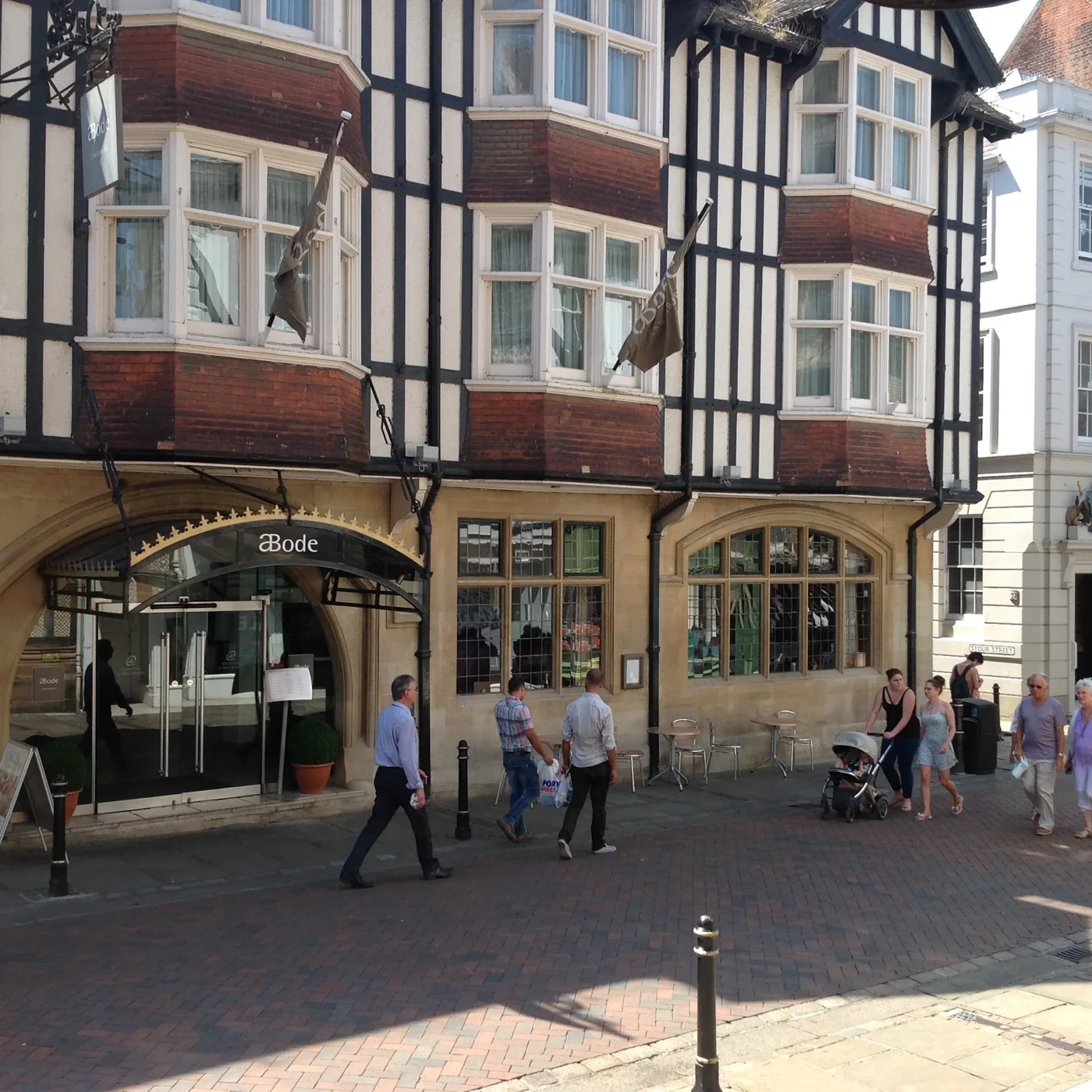
- Five city-centre buildings will change slightly: 1 Pound Lane opposite the Westgate, 39 Burgate, 24 Lower Bridge Street, the ABode at 30-33 High Street and 52 Dover Street.
- If you want to nominate someone, the society takes suggestions, and it says the process can take several years including casting. The criteria page sets out what qualifies.
- You can check any of this yourself on the council’s planning register, using the references below.
Sources
- Canterbury City Council planning register: CA/26/01260 (1 Pound Lane), CA/26/01229 (39 Burgate), CA/26/01230 (24 Lower Bridge Street), CA/26/01231 (30-33 High Street), CA/26/01261 (52 Dover Street) and CA/26/00996 (69 Burgate). Design and heritage statements and case officer reports, accessed 12 September 2026.
- Canterbury Commemoration Society, 21 New Blue Plaques, Criteria for blue plaques in Canterbury, First round of names announced and Plaques away!.
Have your say